
This Laird Technologies case study and product overview highlight the successful integration of the Laird™ BMI-S-608 shielding solution into an automotive Tier 1 company’s program to help it deliver an advanced, multifunction infotainment controller platform for connected vehicles. The company faced formidable challenges including space constraints, thermal transfer and radiated emission issues, and cost pressures. Design engineers required a high-performance EMI shield that could meet automotive-grade standards and needed to address related thermal transfer concerns while simplifying assembly. The Laird™ BMI-S-608 shield frame offers design engineers a compact, one-piece solution that improves EMI mitigation along with thermal contact and transfer, reduces material costs, and enhances manufacturing efficiency. The result: a validated, scalable shielding system that supports the Tier 1’s global OEM programs.
Abstract
This Laird Technologies case study and product overview highlight the successful integration of the Laird™ BMI-S-608 shielding solution into an automotive Tier 1 company’s program to help it deliver an advanced, multifunction infotainment controller platform for connected vehicles. The company faced formidable challenges including space constraints, thermal transfer and radiated emission issues, and cost pressures. Design engineers required a high-performance EMI shield that could meet automotive-grade standards and needed to address related thermal transfer concerns while simplifying assembly. The Laird™ BMI-S-608 shield frame offers design engineers a compact, one-piece solution that improves EMI mitigation along with thermal contact and transfer, reduces material costs, and enhances manufacturing efficiency. The result: a validated, scalable shielding system that supports the Tier 1’s global OEM programs.
 Introduction
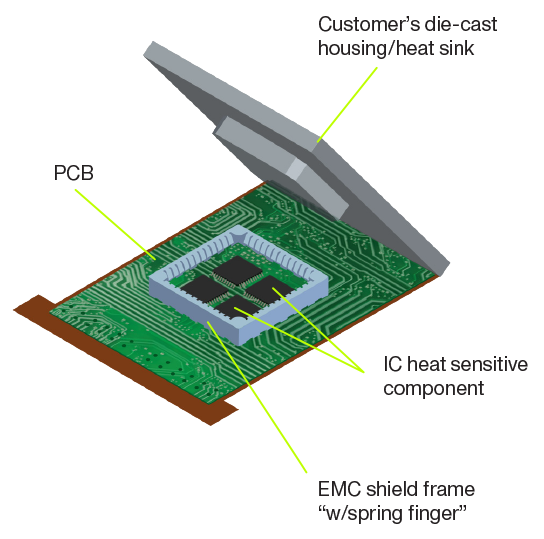
The Laird™ BMI-S-608 shield frame, with its coverless, stainless-steel design, features rows of integrated contact spring fingers positioned on each inner sidewall of the four-sided shield. Traditional shield covers are unnecessary when using this new addition to Laird’s standard board level shield product line. The shield’s structure not only helps mitigate EMI but functions as an integral part of a separate diecast / heatsink main housing to remove excessive heat from integrated circuits.
The shield’s spring fingers grasp the heat sink housing directly. This tightly integrates the heat sink directly with the PCB’s heat-sensitive components. At the Tier 1 company, the diecast / heat sink (replacing the lid normally accompanying metal shielding) and spring fingers (frame) combination provides a shielding and supportive thermal transfer solution surrounding each of three PCBs powering each infotainment controller function. This reduces required spacing between adjacent shields, makes completing repairs easier, and enables design flexibility.
Moreover, incorporating the die cast alone to help enable both EMI shielding and heat dissipation functions offers significant material cost savings for the manufacturer. There is no need to purchase, place, and utilize traditional shield covers.
The Challenges
This automotive program was designed to consolidate multiple electronic functions – infotainment, connectivity, and driver assistance – into a single, compact module. This integration introduced several engineering and manufacturing challenges that demanded next generation shielding solutions:

Space-Constrained PCB Architecture
The module – consisting of two equal-sized top and bottom housings which, when mated, comprised the overall design – featured densely populated PCBs with minimal clearance between components and mechanical interfaces. Traditional multi-piece shielding systems with separate lids and frames were too bulky and incompatible with the tightly packaged envelope. Traditional shield lids had heights preventing module closure. The module required a low-profile shielding solution that could deliver EMI blocking without compromising a designer’s layout flexibility or thermal pathways.
High Thermal Performance Needs
High-performance processors and RF components within the module generate significant heat. The shielding solution needed to facilitate direct thermal contact with the heat sink or die-cast housings to maintain safe operating temperatures. Any obstruction or gap in thermal transfer could lead to performance degradation or failure in the field. The Tier 1 desired using a liquid gap filler for heat transfer.
Assembly Complexity and Cost Pressures
The customer sought to streamline its manufacturing process by reducing part count and manual handling along with the risk of costly rework. Conventional shielding designs often require multiple steps – frame placement, lid attachment, soldering and inspections – adding labor costs and increasing the chance of assembly errors. A simplified, one-step solution was essential to meet production efficiency goals.
EMI Compliance Across Automotive Standards
The module was designed for deployment in global vehicle platforms, each with stringent electromagnetic compatibility (EMC) requirements from regulatory agencies. The shielding solution had to deliver consistent attenuation performance across a wide frequency range, withstand harsh automotive environments, and pass OEM validation protocols without compromise. A custom die cast was needed to both transfer heat and aid in EMI mitigation.
The Solution
The frame, a single-piece integrated solution, is made of a stainless-steel material exhibiting good mechanical performance, a tin / nickel surface finish for solderability, and offering corrosion-resistance performance. BMI-S-608’s four sidewalls help prevent emissions from radiating laterally.
The module’s top and bottom housings play a novel role. No shield lid enabled designers to place PCBs and their hot components in the module’s upper half and the die cast/heat sink in the lower housing. Once united, the solution delivers EMI/thermal protection and a snug, space-saving fit.
Key Features of BMI-S-608
Implementation and Testing
PCB Layout Considerations
Laird field application engineers recommended a soldering footprint layout. This helped ensure an adequate pad layout for SMD mounting. The layout would:
- Be compatible with standard reflow soldering processes
- Use a reflow profile that accommodates the tin-plated stainless-steel material
- Maintain clearance for spring finger compression and contact with the mating heatsink
The Tier 1 would use pick-and-place equipment with appropriate nozzles to populate the shield frame onto PCBAs.
Testing and Validation
Shielding Effectiveness (SE):
- Performance SE tested per MIL-STD-285
- Attenuation measurement across relevant frequency bands
- Performance compared with and without the shield in place
Mechanical Testing:
- Spring finger compression verified consistent contact force at nominal compression
- Use of force-displacement testing to ensure repeatability
- Mechanical shock stress testing to ensure shield remains securely attached and maintains contact integrity
As automotive systems continue to advance in complexity – driven by electrification, connectivity, and autonomous technologies – the need for robust electromagnetic compatibility (EMC) solutions becomes increasingly critical. The Laird™ BMI-S-608 board-level shield frame offers a high-performance approach to protecting sensitive electronics in these demanding environments.
Key Benefits for Long-Term System Integrity

Broad-Spectrum EMI Management:
The BMI-S-608 is engineered to suppress electromagnetic interference across a wide frequency range, supporting compliance with stringent automotive EMC standards. This ensures stable operation of ADAS, V2X, infotainment, and powertrain systems. The shield frame and die cast combination helps achieve full EMI regulatory compliance.
Manufacturing Efficiency:
Compatible with automated SMT and reflow soldering processes, the BMI-S-608 shield supports scalable production and design standards across multiple platforms, helping reduce complexity and costs over time.
Thermal and Mechanical Reliability:
Designed to interface directly with diecast housing or heatsinks, the shield enhances thermal dissipation by allowing the heatsink to have direct contact with the heat source, while maintaining consistent mechanical contact. Again, the shield frame and die cast combination helps achieve full thermal regulatory compliance.
Durability in Harsh Conditions:
Constructed from stainless steel with matte tin plating, the shield offers excellent corrosion resistance and mechanical stability under automotive environmental stresses such as vibration, shock, humidity, and temperature extremes.
Conclusion
The Laird™ BMI-S-608 shield frame delivers a reliable and cost-efficient method for protecting automotive electronics against EMI and signal disruption while supporting thermal management and mechanical integrity. Its versatility and manufacturing compatibility make it a valuable component in the development of next-generation vehicle systems.