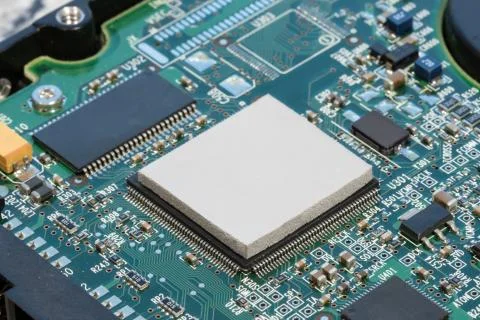
In today’s high-performance electronic systems, thermal management has become a defining factor in reliability and longevity. As devices shrink in size and power densities climb, managing the heat between components and heat sinks is more critical than ever.
That’s where thermal gap fillers are needed for optimal performance of electronic systems. These engineered materials fill microscopic and macroscopic air gaps between heat-generating components and heat-dissipating surfaces in next-generation electronics, from AI-driven servers and EV power control units to aerospace and medical instrumentation. Thermal gap fillers support efficient heat transfer and stable performance over time. Yet with so many formulations and material types available, selecting the right gap filler can be complex.
This guide outlines the key factors to consider—thermal conductivity, thermal resistance, compressibility, softness, outgassing, and more—so engineers can make confident, data-driven material decisions for demanding electronic designs.
Understanding heat transfer and the role of thermal gap fillers
What heat dissipation means for electronic systems
Every active electronic component, from processors and power integrated circuits (ICs) to batteries and sensors, converts part of its electrical energy into heat. If that heat isn’t efficiently dissipated, component temperatures rise. Higher device temperatures can lead to slower performance, shortened lifetime, and potentially device failure.
Traditionally, engineers relied on mechanical fasteners and heat sinks to draw heat away. But as board layouts grow denser, air gaps and uneven surfaces have emerged as major barriers to heat removal. Air is an excellent insulator and a poor conductor of heat, meaning even microscopic voids impact heat transfer, ultimately degrading device and system performance.
How thermal gap fillers improve heat transfer
Thermally conductive gap fillers replace these pockets of air with a compliant, soft material that efficiently transfers heat from the component to the heat sink or chassis. By becoming compressible under low pressure, they conform to uneven topographies, minimizing thermal resistance between hot components and heat sinks and preventing mechanical stress on powerful yet delicate parts.
Compared to other thermal interface materials (TIMs) like greases or phase-change solutions, gap filler pads offer:
- Easier handling and reworkability
- Consistent performance across multiple heat sources
- Reduced mess and waste during assembly
- Compatibility with manual or automated application
- Flexibility across various application, production volumes and levels of manufacturing maturity
For designs with variable component heights, gap fillers can span multiple interfaces simultaneously, making them a preferred choice for engineers designing high-reliability systems.
Key selection criteria for thermal gap fillers
Choosing the right material involves balancing thermal performance, mechanical compliance and long-term reliability. The table below summarizes the primary factors to consider when comparing formulations.
| Selection factors | Definition / Importance | Engineer’s considerations |
| Thermal conductivity | The material’s ability to conduct heat (W/mK) | Higher conductivity enables faster heat transfer; typical range for pads is 1–34 W/mK |
| Thermal resistance | The overall resistance to heat flow across the interface | Minimizes total resistance by optimizing both conductivity and material thickness. |
| Thickness and compressibility | Ability to conform to gaps and surface variations | Select thickness (0.1–2 mm typical) to match tolerances; highly compressible materials reduce stress. |
| Deflection force & softness (shore hardness) | Pressure required to achieve desired deflection | Softer materials can be compressed under low pressure, protecting sensitive components. |
| Electrical insulation | Dielectric strength of the material | Electrically insulated materials protect sensitive electronic components from electrical leakage. |
| Silicone vs. non-silicone | Binder composition of the filler matrix | Non-silicone-based fillers are ideal for optical, sensor, or contamination-sensitive environments. |
| Outgassing and oil bleed | Release or migration of low-molecular-weight compounds | Low outgassing and bleed improve reliability by mitigating hardening over time and prevent fogging of optical lenses. |
| Delamination, pump out and warpage | Mechanical failure under stress, vibration or temperature cycling | Select materials with proven long-term reliability data under operational conditions. |
| Application methods | Manual placement, die-cut pad, or liquid dispensing | Choose based on production volume, automation needs and rework requirements. |
Review Laird’s thermal interface materials brochure for an overview of its full suite of TIMs and comparison tables of performance characteristics.
What is the difference between thermal conductivity and thermal resistance?
While conductivity is often seen as the most important characteristic of thermal material, real-world performance depends on both conductivity and thermal resistance. High conductivity materials transfer heat efficiently, but if the bondline is thick or uneven, total thermal resistance rises. Conversely, thin layers or highly compliant fillers minimize resistance even at moderate conductivities.
Laird offers gap fillers with conductivities ranging from 1.2 W/mK to 34 W/mK, enabling engineers to select the optimal balance between performance and material softness depending on system constraints.
What is the impact of a thermal gap filler’s compressibility, deflection force and softness?
In designs with multiple heat sources or uneven surfaces, compressibility determines how well a gap filler conforms without damaging components.
- Low shore hardness refers to the softness of a material, calculating how much stress a thermal pad puts on fragile ICs.
- Deflection force curves show how much force is required to compress a thermal pad – comparing the compression percentage to how much force is needed to achieve that deflection. The shape of the curve reveals the mechanical compliance and softness of the material.
For ease of integration, Laird produces die-cut and standard sheet gap filler pads in a range of thicknesses that can be tailored to customer geometries, enabling consistent contact and simplified installation.
What is the difference between silicone and non-silicone materials?
Most thermal gap fillers use a silicone binder filled with thermally conductive particles such as boron nitride (BN), zinc oxide (ZnO), or alumina (Al2O3). Silicone-based formulations provide excellent thermal stability and surface wetting, making them ideal for most applications.
However, certain environments—particularly optical, automotive and aerospace applications—require non-silicone alternatives to avoid outgassing and oil bleed. These issues can cause fogging or contamination of lenses, sensors or high-precision assemblies.
Non-silicone gap filler pads can address these issues while maintaining low thermal resistance and mechanical flexibility. Laird offers a comprehensive line of non-silicone-based materials designed for minimal contamination and reliable long-term performance.
How does outgassing and oil bleed impact a thermal gap filler’s long-term reliability?
Over time, silicone compounds can release vapors or oils, which condense on nearby surfaces and cause reliability issues, including:
- Hardening or degradation of the pad over product lifetime
- Reduced optical clarity in sensors or cameras
- Dust attraction and contamination on circuit boards
Low-outgassing formulations help minimize these effects. Engineers evaluating reliability should consider accelerated aging data, thermal cycling results and material stability tests to support consistent performance over years of operation.
What is delamination, pump out and warpage?
Repeated temperature cycling, vibration or mechanical shock can cause materials to shift or separate from the heat-generating surface or heat sink.
- Pump out occurs when a correctly applied filler material is gradually displaced over time, especially in devices with vertical orientations or vibrating assemblies.
- Delamination can occur if surface adhesion or mechanical integrity degrades over time
- Warpage may result from thermal expansion being different among various materials.
To combat these failure modes, engineers should select materials with verified vertical reliability and high mechanical cohesion. In rugged applications, such as automotive power modules or aerospace electronics, this consideration can dramatically extend service life.
Matching gap filler properties to application needs
Each industry places unique demands on thermal interface materials. The table below summarizes common scenarios and the properties that matter most.
| Applications | Key requirements | Recommended material and attributes |
| Automotive (ADAS, lighting, powertrain) | Vibration resistance, temperature cycling, optical safety | Two-part liquid gap fillers or non-silicone-based pads; low outgassing; high reliability under shock/vibrations. |
| AI and | High heat flux, thin bond lines, automation | High-conductivity gap fillers or liquid dispensables; compatibility with automated pick-and-place or robotic dispensing. |
| Aerospace and defense | Reliability, mechanical integrity, low bleed | Non-silicone-based pads with low outgassing and proven long-term stability. |
| Consumer electronics | Compact form factors, reworkability | Soft, thin pads with low shore hardness; easy to apply and remove. |
| Industrial / Medical | Variable gaps, precise thermal control | Compressible gap fillers with dielectric insulation and consistent deflection properties. |
For all of these business sectors, custom die-cut pads and kitted sets help streamline integration into complex assemblies. Laird™ themal gap fillers provide significant value through in-region converting and automation capabilities.
Advancing reliability through high-wattage material innovation
The next generation of thermal interface materials will be driven by demands from AI computing and electrification. Engineers increasingly seek:
- Higher conductivity without sacrificing softness
- Better automation compatibility
- Enhanced reliability under thermal cycling and environmental stress
Emerging technologies such as graphite fibers, which provide high bulk thermal conductivity, are pushing performance boundaries even further. While silicone and non-silicone gap fillers remain the workhorses of today’s designs, continuous innovation will expand options for tomorrow’s high-power, high-density layouts of devices and systems.
Building a reliable thermal pathway
Selecting the right thermal gap filler is a system-level choice that affects performance, manufacturability and reliability. By evaluating factors such as thermal conductivity, compressibility, softness, outgassing, and application methods, engineers can help safeguard optimal heat transfer and long-term device stability.
For many applications, that means balancing performance and process, choosing materials that conduct heat efficiently, apply cleanly and remain stable throughout a product’s lifetime.
Laird’s portfolio of thermally conductive gap filler pads and liquid gap fillers—available in both silicone and non-silicone-based formulations—helps engineers achieve that balance with proven reliability across automotive, data center, aerospace, and consumer electronics designs.
By taking a structured, criteria-based approach to material selection, design engineers can create systems that stay cooler, last longer, and perform exactly as intended, even under some of the most demanding conditions.