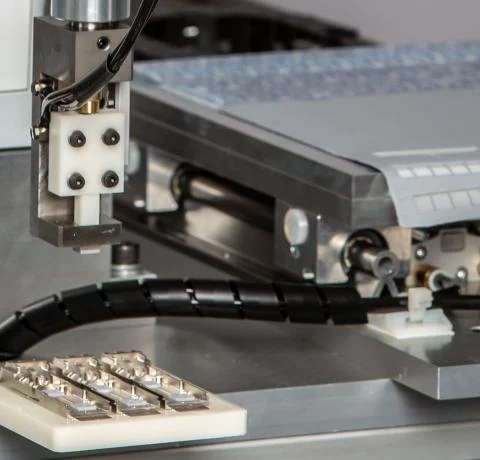
Read from a Laird expert how we have automated the application of all forms of thermal interface materials, including phase-change materials and die-cut gap fillers.
Read below:
The final frontier of automation in electronics manufacturing
You might be surprised to learn that a crucial component inside complex electronics – from video game consoles to electric vehicle powertrains – is applied painstakingly by hand.
I’m talking about thermal interface materials (TIM) – tiny, yet vitally important elements within high-powered electronics. TIMs help ensure reliable product performance by efficiently transferring heat from heat-generating components to heat-dissipating components.
By manually applying these TIMs, however, electronics manufacturers face limits when it comes to operational efficiency and yields. Installation errors lead to increased scrap, hurt product performance, and can even cause product failure.
These shortcomings will only grow as design engineers seek to include more and more heat-producing components in less and less space. It’s time for manufacturers to do away with these manual processes in electronics manufacturing to keep up with ever-increasing processing demands and generate savings.
New alternatives to “peel and stick”
TIMs come in a variety of forms, including pads, putties, phase-change materials, thermal greases, and thermally conductive insulator materials. They fill the air gaps and microscopic irregularities between electronic components and a heat sink and direct heat from heat-generating components to heat-dissipating sources.
A manufacturer’s TIM needs vary. Some design engineers may need to fill thin gaps between components and heat sinks. In these cases, they can use grease or thermally conductive phase-change materials. Design engineers can address thick gaps with die-cut or dispensable gap fillers.
While automation exists for the application of dispensable TIMs, such as dispensable gap fillers and thermally conductive grease, applying phase-change materials and die-cut gap fillers remains stubbornly manual. Workers use “peel and stick” processes to apply these TIMs: A line worker peels a tiny pad from a sheet and places it on a heat sink or electronic component part. Of course, precision is crucial. If the worker applies the TIM in a way that exposes a section of the sink or component – even if it’s just a millimeter off – it could produce a hot spot that can put the device over temperature limits and damage product operation.
Comprehensive automation for TIM applications
Fortunately for electronics manufacturers, automation solutions are emerging that allow for consistent and fast application of all forms of TIMs. Laird Performance Materials recently released a TIM automation product suite that addresses organizations’ full scope of TIM application needs.
Laird Performance Materials’ product portfolio now includes automation solutions for the application of die-cut phase-change and gap-filler pads, in addition to its existing dispensable TIM automation solutions.
TIM Pick™ uses robotic-controlled pick-and-place technology to cut and remove a gap filler from a sheet and place it onto an electronic component in a seamless and efficient motion. TIM Print™ uses a simple die-and-press process to print a phase-change pad onto a heat sink, lid or board-level shield.
In one instance, we found that TIM Print improved yields by more than 10%, lowered labor requirements by 14 operators and improved cycle times by more than 60% compared to manual application processes. Over the life of this program, TIM Print offered the manufacturer more than $1 million additional savings.
This comprehensive automation of TIM products and application processes now gives design engineers more options. Instead of being limited to using dispensable TIMs, engineers can now use phase-change materials or gap-filler pads without sacrificing efficiency and product throughput. With all forms of TIMs at their disposal, design engineers can more successfully lower thermal resistance in their products and optimize design.
The future of automation
Automation in electronics manufacturing processes doesn’t end with TIMs. This expanded use of automation can eventually apply to application of other materials, such as RF/microwave absorbers, which absorb or suppress stray electromagnetic interference.
There are significant efficiency and performance gains associated with the automation of TIM application processes. Design engineers should take note and push their organizations toward increased adoption of automation. The electronics manufacturers that embrace comprehensive TIM automation will be prepared to handle the increasing power and processing demands that accompany ongoing industry innovation and the arrival of 5G.
Follow Laird Performance Materials on LinkedIn for more information about the automation of TIM application processes.