As electronic systems grow smaller, faster and more powerful, effective thermal management has become one of the most critical design challenges engineers face today. From automotive lighting to AI data centers, every watt of power generates heat that must be dissipated to maintain device performance and reliability.
Selecting the right thermal interface material (TIM) is essential. TIMs, which transfer heat from components to heat sinks, are available in a variety of formats and formulations. Among the most widely used TIMs are liquid thermal interface materials and thermal gap filler pads. Both serve the same purpose—efficient heat transfer—but their characteristics, application methods and performance profiles differ in key ways.
This article explores how these materials work, where they are best suited and what factors engineers should consider when choosing among them.
Understanding the Role of Thermal Interface Materials
All electronic devices generate heat, and most components, such as integrated circuits, power transistors, or GPUs, must maintain specific operating temperatures to function reliably. Thermal interface materials fill microscopic air gaps and uneven surfaces between heat-generating devices and heat sinks, enabling smoother and faster heat transfer.
Without a TIM, trapped air (an inefficient thermal conductor) can lead to localized hot spots, degraded performance and premature failure. High-performance TIMs reduce thermal resistance, allowing heat to move efficiently from component to heat sink and preventing devices from overheating.
Two of the most common TIM categories are liquid thermal interface materials and thermal gap filler pads. While both materials are thermally conductive, their structure and application methods make them better suited for different types of assemblies.
What Are Liquid Thermal Interface Materials?
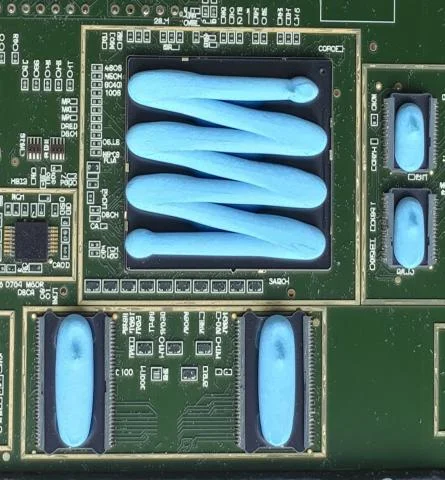
Liquid thermal interface materials—also known as liquid gap fillers, dispensable thermal gap fillers or thermal gels—are soft, thermally conductive materials applied as a viscous liquid that conforms precisely to the surfaces it contacts. Once dispensed and after compression, the material helps fill voids between the heat source and heat sink, minimizing contact resistance and maximizing heat transfer.
Laird’s portfolio includes both one-part and two-part liquid gap filler formulations:
- One-part materials, such as the Laird™ Tputty™ Series, maintain their viscoelastic nature, minimizing stress on electronic components during use while serving as a robust interface material in vertical applications.
- Two-part curable materials, like the Laird™ Tflex™ CR Series, cure in place to form a soft, elastomeric structure that further resists pump-out, vibration, and thermal cycling in more demanding applications—critical in automotive, industrial, or aerospace environments.
- Reduced mess and waste during assembly
- Compatibility with manual or automated application
- Thermal gels, such as Tgel™ 600, are partially cured dispensable solutions that work in both thin bondline and large gap applications and offer excellent reworkability.
Liquid thermal interface materials are also available in silicone and non-silicone formulations. For applications such as automotive camera modules, sensors, or optical assemblies, non-silicone-based products help prevent outgassing and oil bleed, which can otherwise degrade or contaminate sensitive components.
Dispensable thermal gap fillers are typically applied using automated dispensing systems, offering consistent coverage and efficient high-volume production. Their ability to conform to complex geometries and variable gap dimensions makes them an excellent choice for electronics cooling in densely packed designs.

What Are Thermal Gap Filler Pads?
Thermal gap filler pads are solid, pre-formed TIMs composed of soft, compliant silicone or non-silicone-based materials filled with thermally conductive particles. They are typically die-cut into custom shapes and thicknesses, then placed between components and heat sinks to provide reliable thermal contact.
Pads are especially useful for applications that demand consistent thickness and easy handling, or where rework and replacement may be necessary. Laird™ gap filler products are engineered to balance low hardness and low peak stresses, providing the desired balance of compressibility and high thermal conductivity to support optimal thermal performance.
While pads must be physically placed—either manually or with pick-and-place automation—they provide clean, repeatable results and are ideal for lower-volume production or assemblies where automation is not required.
Thermal Gels vs. Pads: A Direct Comparison
| Property | Liquid Gap Fillers | Gap Filler Pads |
| Form | Flowable liquid or gel | Pre-formed solid pad |
| Application | Dispensed via automated equipment | Manually placed or pick-and-place |
| Curing Options | One-part (non-curing), two-part (curable) and gel (pre-cured) | Pre-cured |
| Surface Conformability | Excellent – conforms to complex topographies | Good – dictated by pad thickness |
| Automation Compatibility | High – ideal for automated lines | Moderate – manual or semi-automated |
| Reworkability | Moderate | High |
| Reliability (Shock/Vibration) | Excellent with two-part cured systems | Good with high-compliance materials |
| Best For | High-volume, automated assembly; irregular surfaces | Manual assembly; consistent geometries |
Both materials achieve excellent heat transfer, but their functionality and performance depend on the specific application environment and assembly process.
Selecting the Right Material for Your Design
When determining whether a liquid thermal interface material or gap filler pad is right for your design, consider the following factors:
1. Gap Size and Surface Flatness
- For variable gaps or uneven surfaces, liquid gap fillers perform best, as their flowable nature fills voids with minimal stress on components. Liquid TIMs can also help achieve microscopically thin bondlines in tight spaces.
- For uniform surfaces, pads offer simplicity and repeatability.
2. Automation Requirements
- Dispensable thermal gap fillers integrate seamlessly into automated dispensing systems, helping improve throughput and consistency for high-volume manufacturing.
- Pads are well-suited for manual or semi-automated assembly, especially in smaller production runs.
3. Reliability and Durability
- Two-part curable liquid TIMs provide superior resistance to vibration, shock, and temperature cycling, making them ideal for automotive and aerospace applications.
- Pads can also perform well in these environments when combined with proper compression and alignment control.
4. Reworkability and Serviceability
- Thermal gels can be removed most easily but fresh material needs to be used during rework and assembly.
- Pads offer moderate reworkability but may tear or become deformed if reused.
5. Material Composition
- Choose non-silicone materials for optical or camera applications, or where outgassing must be minimized.
- Silicone materials often deliver highest temperature stability and flexibility in general electronics applications.

Real-World Applications
Automotive Systems:
Liquid gap fillers such as the Laird™ Tflex™ CR Series provide reliable thermal connections in EV Powertrain units (On-board chargers), ADAS units, LED lighting, and power conversion modules. Their cured structure can help maintain integrity even under mechanical stress and temperature cycling.
Data Centers and AI Systems:
Complex, high-power GPUs and CPUs generate extreme heat densities. Dispensed liquid thermal interface materials help fill every gap, supporting more uniform heat transfer and extending equipment lifespan, particularly on fragile components found on a PCB board.
Consumer Electronics:
Thermal gap filler pads are commonly used in laptops, gaming consoles, and handheld devices, balancing manufacturability with strong thermal management performance.
Aerospace and Defense:
In environments where non-silicone-based solutions are required, liquid gap fillers offer reliability with minimal risk of oil bleed or material migration that could affect sensitive optical or radio frequency components.
Industrial:
Thermal gap filler pads are commonly used across a wide range of industrial applications, such as autonomous mobile robots (AMR) and automated guided vehicles (AGV). Gap filler pads are user friendly and offer easy implementation for high-volume production.
The Future of Electronics Cooling
The next generation of electronic systems demands materials that deliver higher conductivity, thinner bondlines and better reliability.
Laird’s R&D teams continue to develop advanced materials that address these challenges, developing new formulations to reach higher levels of thermal conductivity and offer additional benefits that enable next-level performance. Automation and precision dispensing will also continue to drive the adoption of dispensable thermal gap fillers, helping manufacturers to achieve consistent, scalable electronics cooling solutions.

Selecting the Ideal Thermal Interface Material for Reliable Electronics Cooling
Choosing between liquid thermal interface materials and thermal gap filler pads ultimately depends on your system’s design, production method and performance requirements. Liquid gap fillers and thermal gels offer outstanding automation compatibility with and adaptability for complex assemblies. Thermal pads provide simplicity, ease of handling and reliable performance in well-defined geometries.
Both options, when engineered with precision and applied correctly, can significantly help improve heat dissipation and long-term device reliability.
To analyze advanced solutions for your next design, explore Laird’s full range of liquid thermal interface materials.