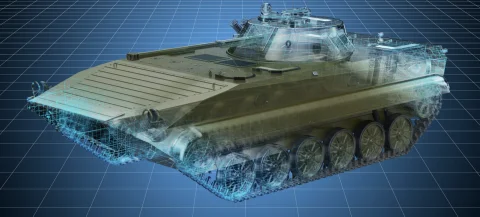
Military electronics are becoming increasingly sophisticated, especially those shielding warfighters. While military electronics capabilities can be staggering, their eye-popping functionality can be stymied when designers seeking to solve simultaneous EMI and thermal issues realize needed board space is non-existent. In this paper, Laird presents a case for increased application of multifunctional solutions. These innovative products today are solving thermal, EMI, and structural issues simultaneously but use a single, space-saving design. We also describe myriad Laird capabilities to validate design work in its earliest stages.
Bringing in Multifunctional Design Help
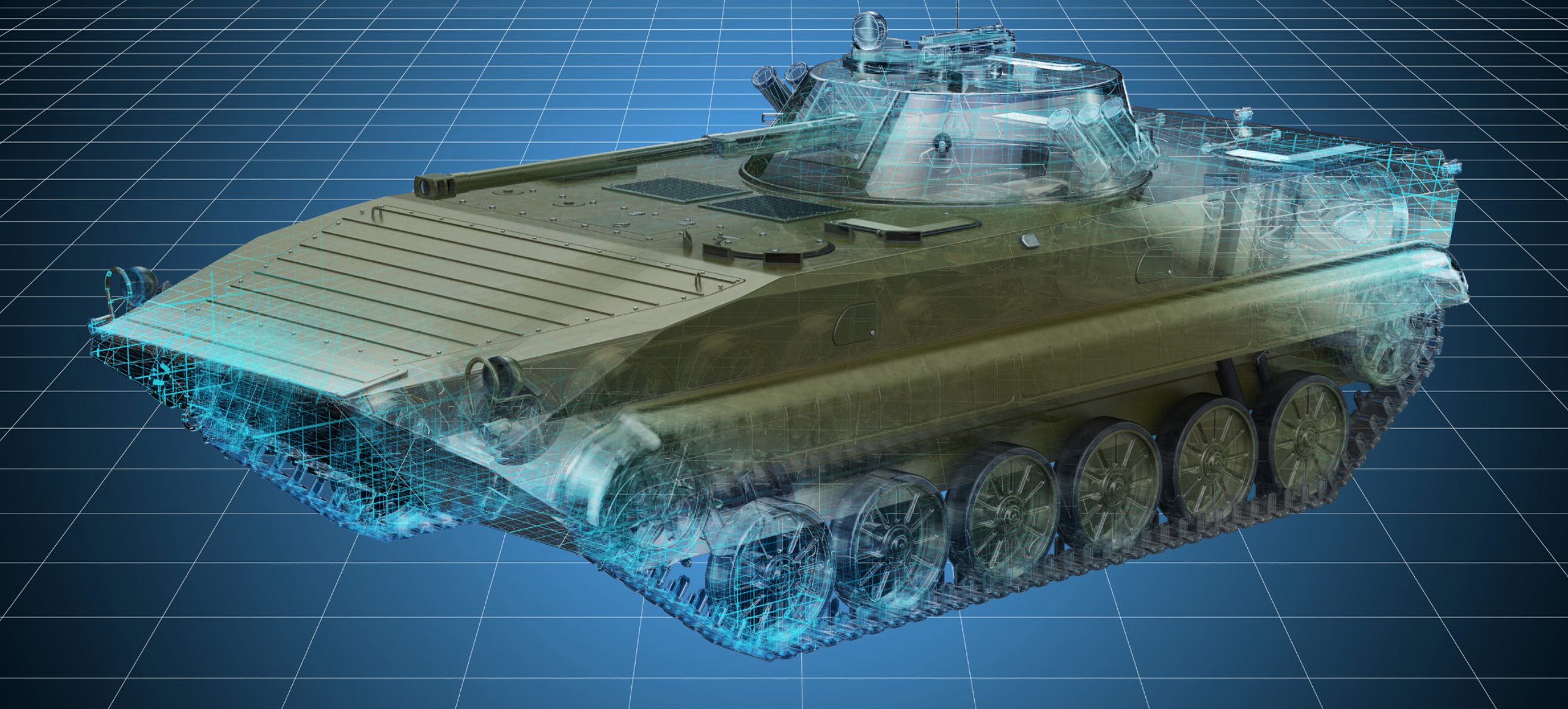
Looking for help is likely at least as old as when prehistoric humans found themselves facing a saber-toothed tiger and hoped getting some additional bodies might even the odds.
People learn from the cradle to look for help. But like in so many things, timing is everything. Too often someone will wait until major problems develop and then look for a rescue. The longer you wait, the more difficult it can be to improve the situation, even with assistance.
That’s true in engineering. If there’s a particular aspect of a project that is out of your experience, the best way to complete it might be to get help. So, get advice, an experienced eye, or a suggestion from someone who knows, but do it earlier on, not later.
A small course correction early has a multiplier effect and can set things aright with less effort. When it comes to milspec vehicular design and the many issues that the combination of rugged environments, complex tradeoffs, and the need to control for EMI, temperature, exposure to corrosive materials, vibrations, and critical requirements, Laird is a good one to have around.
With roots tracing to 1824 and Great Britain’s shipbuilding industry, Laird Performance Materials enables and protects billions of electronic devices from harmful heat, disruptive electromagnetic interference, or both, as well as adding to the structural integrity of those devices. We’ve seen virtually all the variations of what can happen, have fixed many a difficult situation, and we can help you.
Why Get Help
The short answer is because you need it. Slightly longer: everyone does at times and even if someone has been in the industry for years, they will never have all the answers at their fingertips.
There are many challenges facing military vehicular design. In the context of what Laird does, questions could come from needs in electromagnetic interference like high-frequency noise, extreme temperatures and temperature gradients, power and heat dissipation, and environmental sealing.
Each new vehicle type is related to others, but likely will bring up considerations no one had expected. A new design of ship or aircraft or submarine or tank or personnel carrier can unearth problems in new ways. Developing solutions and then prototypes in a laboratory setting is a normal part of the design process. So is bringing early attempts out into the real world only to find that unexpected conditions, interactions, uses, and demands can shine spotlights on weaknesses no one realized were there.
Engineering silos, where different groups concentrate on specific areas, whether on the inside of a vehicle or the outside, or maybe in EMI or heat transfer or corrosion measures, can be another reason to seek help. Actions taken by one group could have unexpected side effects that spill over and set back the work of another group. This can be particularly true in understanding the full holistic impact of decisions, especially as system architects who controlled the overall design have likely moved on to new projects.
Then there is the needed knowledge of products and materials that can help. Specialty product vendors frequently will know more about the available types of solutions; differences among their variations; trade-offs of performance, size, type, and price; and how products can combine to offer uncommon solutions to problems designers haven’t run into before. Experienced vendors like Laird have the capabilities to create custom solutions that will be new, and so something engineers in a company would likely have not heard of before.
Even with in-house expertise that could eventually solve whatever problems had presented themselves, time becomes a critical factor. Federal contracts have explicit schedules and milestones. There are likely penalties for nonperformance, which would include late delivery of initial concepts, prototypes, final designs, and production runs. Delivery speed becomes part of the eventual cash cycle. A contractor or subcontractor that misses timely performance will likely also miss timely payments. Getting engineering help can mean nothing more than increasing the number of human resources to get the job done and without casting dispersions about an engineer’s knowledge and value.
When to Get Help
There are many times in a project where a company might look for help from a vendor like Laird. One is early on or even at the very onset of a project. Laird personnel have discussed requirements of a future project, helping with board-level shields design or on the consideration of custom precision materials.
Something we’ve done frequently is to assemble a design first-aid kit of EMI products for a specific customer and project. These are mixes of product and materials samples that, after a consultation, Laird engineers think could be of help at some point during early design and prototyping. When problems appear in the lab or on early field tests, the company can try some of the components that might address what has come up and see which is be most promising. They can then call, explain what happened and what they tried, discuss the results, and the Laird engineers can suggest modifications to tune the fix.
Or a call for help might come later, when real-world conditions bring out complications for the first time. The point is to embrace the opportunity for help and recognize that doing so is an intelligent decision that will ultimately improve the product, save money in the long run, keep progress on schedule, or a little of each.
Examples of Help
Laird’s application for assistance questionnaires can help a group direct a thought process that can itself be helpful. For example, is the question about EMI mitigation, thermal transfer, or circuit signal integrity issues? Are there multiple inter-related issues occurring? What is the type of environment? What is the operating frequency range of signals? Is grounding or attenuation required? Thermal conductivity? Electrical isolation?
Our expertise includes mechanical (FEA), thermal, and electro-magnetic simulation capabilities. We can help with rapid prototyping, advanced testing, tooling, or automation.
Suggesting standard or custom multifunctional solutions can help span concerns across engineering functional silos for a full view of designs and how making one change can introduce other unexpected results.
Precision metal simulation can let us predict formability and spring-back as well as force, stress, and permanent set versus displacement. Realistic 3D analysis in addition to simulating behavior of our own sheet metal parts can also show the impact on other assembly components. Simulation complexity depends on your needs, from quick early-stage design iterations to stage design iterations, to fully realistic final design verifications, including elastic and plastic base materials and plating layers with residual stress, and complex boundary conditions with dynamics and friction. Typical outputs include stress, strain, contact forces and pressure.
Electromagnetic modeling tools include 3D full wave solving, frequency domain analysis, finite integration technique in the time domain, and circuit simulation.
Thermal modeling services use computational fluid dynamics for accurate thermal modeling of electronics, including transients, boundary conditions, the ability to model component thermal properties using a variety of representations, and capabilities to consider altitude and liquid-cooled systems.
We can perform elastomer simulations: extruded products, molded and composite products, and simulation validation. Also, reflection arches, transmission tunnels, impedance analysis, reflection, and material property measurements.
Integrated Solutions engineering services include design, procurement, and automation of system elements that can be integrated into a single Multifunction Solution (MFS) to solve increasingly complex & inter-related (mechanical, thermal, electro-magnetic) challenges. Examples include heat sink assemblies, heat spreaders, absorber board level shield assemblies, etc. The use of MFS can reduce system and manufacturing complexity.
Our dedicated R&D analysis facilities include particle size analysis, thermal conductivity, TGA and DSC, pycnometer, salt fog chamber, volume resistivity, thermal and humidity chambers, and lab mixers and presses.
Among our testing capabilities are thermal shock; bake; HAST; power cycling thermal cycling; thermal conductivity, resistance, and diffusivity; thermogravimetric analysis, particle analysis, density, and deflection. We can address industry trends in product miniaturization and increasing electronic densities.
All this requires specialized hardware and software that few companies are likely to have on hand, which becomes another way we can help.
Conclusion
The ultimate point is that Laird has resources, equipment, expertise, and personnel to accelerate innovation at times a design group runs into problems or wants to gain the advantages of what we can bring to a project.
Advanced product modeling strengthens the ability to define desired product attributes. Modeling also helps in overseeing actual design and better analyzing and documenting products under development. We carefully simulate anticipated environments in which products are expected to perform flawlessly over the long term. Most critically, Laird engages the world’s best predictive performance tools, each noted for precisely forecasting potential issues of concern and guiding possible modifications. Design engineers enjoy peace of mind when engaging Laird’s modeling and simulation capabilities.
Our design engineers and field application engineers are experts in materials sciences and mechanical and electrical engineering, with decades of designing solutions for the toughest heat, EMI, and compliance-related problems that manufacturers face. That’s why design engineers from the world’s leading technology brands look to Laird for co-designed solutions when they need to transfer heat, lower thermal resistance, or reduce the effects of radiated energy.
We work with manufacturers across the world to co-design products specifically to solve the heat, EMI and compliance challenges that can thwart the performance of their advanced electronics. Laird’s 3 military engineering sites, testing labs and design centers serve the nation’s largest and most prestigious manufacturers in a wide mix of industries. Also, we can now tap the expertise of and integrate technology from our parent company, DuPont.
When you need help, it’s good to have access to people who can get you past your problems and into solutions that keep your projects on track for success.
Get a little help from your friends at Laird.
About Laird Performance Materials (Laird)
Laird Performance Materials, integrated into DuPont Electronics & Industrial’s Interconnect Solutions (ICS) business, solves signal integrity and power transmission issues. We enable high-performance electronics by creating protection solutions for advanced interconnects and systems. World-leading technology brands rely on Laird for improved protection and helping accelerate their products’ time-to-market. A global brand, Laird solves design issues by providing Laird™ branded innovative products such as EMI suppression or absorption materials, thermal interface materials, structural and precision metals, magnetic ceramic products, and multi-functional solutions (MFS). The Laird™ MFS product family solves multiple EMI, thermal and structural design issues simultaneously using a single process design. Visit Laird at https://www.laird.com.
Copyright © 2022, Laird Technologies, Inc. DuPont™, Laird™, Laird Performance Materials™, and corresponding logos, are trademarks owned by Laird Technologies, Inc., DuPont de Nemours, Inc., or their subsidiaries. All rights reserved.