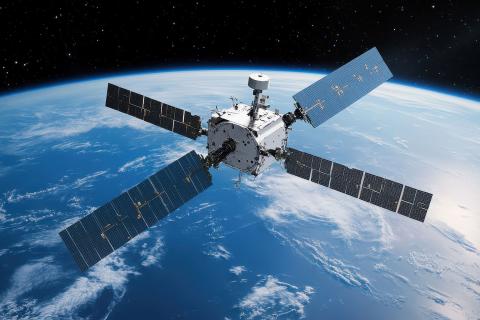
Excess heat threatens the reliable operation of low-earth orbit satellites. Learn how Laird Technologies used traditional space-rated materials in novel ways to help an aerospace manufacturer address PCB-generated heat in its satellite systems.
Dissipating heat on low-earth orbit satellites
Design engineers working on low-earth orbit satellites face numerous challenges, from electromagnetic interference and solar radiation to strict weight limits and materials survivability. One of the most critical challenges is heat. Managing it is essential to ensuring the operational longevity of sensitive components. Engineers must deliver reliable satellite performance through continuous thermal cycles in the harsh environment of space.
Satellite PCBs, while indirectly subjected to temperature extremes, have become focal points for aerospace design engineers as they seek to improve thermal management. These PCBs, which enable sensors, communications, and uplink/downlink operations, must meet stringent design-space and weight requirements. They also face several unique demands and must:
- Mitigate EMI/RFI.
- Be radiation hardened.
- Control outgassing that may affect other components.
- Survive solder and assembly processes.
- Dissipate heat effectively.
There are few repair options once a satellite is in orbit. So, engineering teams should address these issues early in the design process and design complete thermal pathways capable of radiating heat efficiently into space.
The only viable heat dissipation mechanism in space
In the vacuum of space, radiation via emissivity is the sole mechanism for heat dissipation. Emissivity quantifies how well a material emits thermal radiation (higher values are generally better). As power densities rise and design envelopes shrink, engineers need higher-performing materials.
Laird Technologies recently partnered with an aerospace manufacturer to address significant PCB-generated heat in its satellite systems. Due to project constraints, the team had to use traditional space-rated materials in novel ways.
Effective thermal control required balancing emissivity, absorptivity, and reflectivity, ensuring that the PCBs minimized solar heat absorption while maximizing radiated emission of heat to the cosmic background.
To address this complex thermal management challenge, Laird developed a distributed heat dissipation design at the PCB level, rather than the system level. This unconventional approach combined polymer composites with precision metal board-level shields to create radiant heat sinks. The design minimized reliance on conduction or convection, leveraging radiation as the primary heat-transfer mode. It also eliminated bulky, costly traditional thermal solutions and enabled more uniform thermal performance across the device.

A novel materials stack for orbit-ready reliability
Low-earth orbit is among the harshest operational environments. While the atmosphere is nearly absent, collisions with the remaining high-energy particles, such as atomic oxygen, can sever even the strongest chemical bonds. Additionally, UV and space radiation are intense. These environmental challenges can degrade, discolor, or ablate organic materials quickly, ultimately altering their optical properties.
Any drift in emissivity, absorptivity, or reflectivity could compromise PCB function and system performance. Properties must remain stable to ensure long-term thermal reliability. Laird offered advanced materials solutions designed to support the reliable operation of the company’s satellites from launch to deorbit.
While there are many high-temperature, space-rated polymers such as polyimides and aramids, these materials tend to degrade more noticeably under long-term radiation or atomic oxygen exposure. They also often experience shifts in optical properties over time, which can disrupt stable heat dissipation. These drawbacks made them less than ideal for sustaining consistent emissivity and absorptivity over the satellite’s operational life.
So, what kind of material can deliver high reflectivity, high emissivity, and low absorptivity, while surviving both space exposure and PCB manufacturing?
Fluoropolymers offer unmatched resistance to radiation and atomic oxygen with minimal property degradation. However, they come with drawbacks: low emissivity in thin films, high molecular weight, and transparency, meaning minimal intrinsic reflectivity.
To overcome these issues, engineers can add a thin vapor-deposited metal layer such as silver, aluminum, or gold on the backside of the fluoropolymer (which is what the Laird team did in this case). This configuration reflects broadband solar radiation while the fluoropolymer emits narrowband thermal energy. Increasing the thickness of the fluoropolymer increases emissivity and balances the thermal output. This solution creates a second-surface mirror, a proven tool in spacecraft thermal control.
Traditionally used on the external surfaces of a spacecraft, second-surface mirrors minimize solar heating and radiate heat when oriented away from the sun. The Laird team went beyond traditional uses of second-surface mirrors in aerospace applications and integrated them directly onto PCBs by laminating them to precision metal components. This implementation approach created localized radiant heat sinks that met thermal goals without significant weight penalties.
Further, by distributing the heat sinks across the PCB, the design increased the effective radiative surface area and reduced power density in any single location. It also made the thermal design orientation-agnostic, performing consistently regardless of the satellite’s position relative to the sun. Importantly, the system met all outgassing requirements and resisted UV, atomic oxygen, and thermal cycling, enabling long-term stability.
With the right material stack, space itself becomes a dependable heat sink. Strategic material selection and integration allows every watt of waste heat to find a path outward.
Blending advanced materials and precision engineering
As thermal loads grow and design margins shrink, managing heat has become more challenging. However, addressing thermal challenges is essential to enabling innovation and performance in space. By combining materials in novel ways and embedding cooling architectures into electronics to create integrated thermal solutions, engineers can address thermal, size, and weight challenges while minimizing system complexity.
