Learn how an innovative Laird Technologies material enabled a thinner bondline with an 18% lighter weight solution and resolved last-minute heat transfer issues.
Miniaturization trends sweeping across today’s PCB landscape are inspiring the reimagination of designs. This inspired design creativity is reflected everywhere on a PCB, from traces, power inductors, and capacitors, to graphics processing units (GPUs), integrated circuits (ICs), memory chips, and PCB multilayering.
Wearable technology is capitalizing from the rapid progress of miniaturization. Design innovations in wearable technology are nowhere more evident than in today’s smaller, lightweight, body-hugging, feature-rich devices. Among dozens of examples are augmented reality and virtual reality gear, smartwatches, web-enabled eyeglasses, fitness trackers, and other wearable health devices.
Wearable technology global shipments surpassed 500 million units in 2024 alone, according to the Worldwide Quarterly Wearable Device Tracker of International Data Corporation (IDC). IDC reports that 2.5 billion wearable devices have been shipped globally since 2020.
In addition, Maximize Market Research projects that the global wearable technology market will hit USD148 billion by 2030, up from USD60 billion in 2023. The forecast is for long-term growth.
A design balancing act
Devices with robust growth potential face complex design challenges. During testing, team members at an electronics products manufacturer who were tasked with developing a next-generation wearable technology realized that they needed prompt action to mitigate increased heat generation. Advanced GPUs driving the next-gen product needed improved cooling. The thermal interface material (TIM) used for earlier devices could not address the increased heat transfer within the limited space of the small device. Added heat dissipation needs had been identified, yet the scheduled next-gen design was mostly locked in.
The team needed to mitigate potential heat transfer issues on two fronts simultaneously. Team members had to engage in a delicate balancing act between achieving an interface bondline thickness that enhanced the overall thermal performance and saved space while at the same time finding a thermal material offering reduced weight.
The first hurdle of the package design was extremely tight spacing, along with the need to create a thinner bondline to enable integrated circuit-generated heat to travel shorter distances to heat sinks. Added user features and greater functionality were to be offered as well. Still, as designed, the package also led to extreme component crowding coupled with extreme cooling demands.
Densely packed components would require that only the thinnest of TIMs could be specified to meet the interface bondline objective of saving space. Establishing a thinner bondline was essential. The desired bondline thickness of the next-gen application needed to be less than the diameter of a human hair, requiring a solution assumed to be unlike any other dispensable TIM.
Related to the first hurdle was the second issue: weight. Wearable technology consumers continue to demand lightweight, comfortable-to-use devices. Manufacturers in turn are designing and producing high functionality wearable devices that feature lower overall device weight to satisfy consumer expectations.
The design team knew it was imperative to resolve TIM weight concerns, the extreme space limitations, and find a workable balance. At the same time, it needed to ensure it would meet its goal of lowering thermal resistance to improve heat transfer, using the shortest possible IC to heat sink distance.
To validate whether the TIM used for its earlier generation wearable technology could be used again, the team conducted evaluations. Could the current TIM remain the choice for the next gen device? The manufacturer’s objective was identifying one TIM to satisfy multiple needs.
Buyer demands versus design requirements
Achieving a balance between buyer and design performance requirements is never easy and was evident again here. To satisfy wearable technology users, designers needed to deliver robust, high power, reliable functionality within a compact, lightweight design.
Designers of wearables also must remain mindful of ensuring skin and user-touch comfort. Their overall goal is one solution meeting the stringent design requirements tied to space, weight, and thermal transfer performance as well as the varying demands of users.

Collaboration, samples, testing produce success
Laird Technologies, a DuPont business, was asked by the manufacturer to evaluate the thermal management concerns, begin intense collaboration, and find answers - all in less than two months. Field application engineers at Laird routinely work hand in hand with manufacturer design teams to understand principal and secondary issues and design requirements while also identifying potential obstacles to overcome. Laird’s field application engineers were engaged from the start. Along with a range of additional technical personnel from across Laird, they conducted problem-solving discussions with the design team, delivering key data and thus helping ensure deadlines would be met.
Production samples of dispensable Laird™ branded TIMs were rushed to the design team. The team conducted lab evaluations of both Laird™ branded TIMs and those of competing dispensable TIM manufacturers. Several candidates were dismissed after evaluations due to lack of thin bondline capabilities, weight, or other factors.
Included in samples testing were traditional thermal grease and phase change materials. Thermal grease is more prone to material pump-out issues or slippage/leakage at the 300 to 350 μm gap size. Phase change material typically needs a separate burn-in process and cannot be dispensed in a manner like the manufacturer’s previously used liquid gap filler material. Testing these materials would require a longer period of time as well.
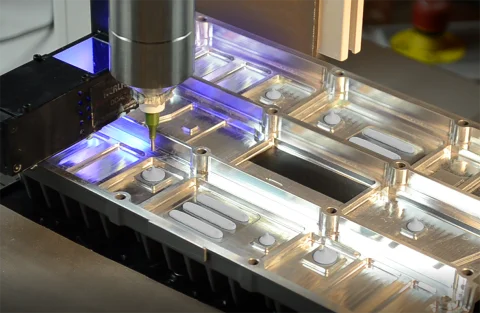
Beating its deadline, the design team selected newly introduced Laird™ Tgel™ 600 thermal gel that has a thin bondline, high thermal conductivity, and is lightweight. It met each need of the design team and enabled increased throughput dispensing. Unlike other dispensable gap filler materials or thermal grease, Tgel™ 600 thermal gel can fill small, fixed-gap applications of under 100 μm. It can be used in constant pressure applications as a grease or used in constant gap applications as a gap filler.
Attains minimum bondline thickness
The bond line of Tgel™ 600 thermal gel is 20 microns, a key deciding factor for the design team. The average diameter of a human hair is 75 microns. Tgel™ 600 thermal gel also provides cost savings because less material is used per application with no loss of low thermal resistance properties.
Reduces weight
Tgel™ 600 thermal gel provides 6.4 W/mK bulk thermal conductivity. Its density is only 2.63 g/cc, thus ensuring a vital 18 percent reduction in weight from the TIM (3.20 g/cc density) the design team had specified for the earlier-generation device.
Rapid flow rate
Rapid flow rate is a crucial factor in expediting mass assembly. The smooth consistency of Tgel™ 600 material promotes a faster flow rate using standard automated dispensing equipment.

Summary
This collaboration between a time-pressed wearable technology design team and Laird’s engineering team illustrates the importance of early detection of problems - and prompt action to resolve them. The path to product launch success is marked by quick acceptance of issues threatening product performance, adherence to established deadlines, and collaboration with a broad range of experts to construct and execute a winning game plan.
Copyright @2025, Laird Technologies, Inc. DuPont™, Laird™, the Laird Logo, and all trademarks and service marks are owned by DuPont de Nemours, Inc., Laird Technologies, Inc., or their affiliated companies. All rights reserved.